Mono vs 4-Channel Car Amplifier: Which One Do You Need?
Quick answer: Choose a mono amplifier to power subwoofers and a 4-channel amplifier to power door and rear speakers. A mono amp sends all its power through one channel at low impedance for bass, while a 4-channel amp splits power across four speakers. For a full system, use one of each or a 5-channel amp.
Choosing between a mono and a 4-channel car amplifier comes down to one question: what do you want to power? A mono amplifier, also called a monoblock, sends all of its power through a single channel to drive subwoofers. A 4-channel amplifier splits its power across four channels to run your door and rear speakers, or a pair of speakers plus a bridged subwoofer.
Pick the wrong one and you either leave your speakers starved for power or try to run a subwoofer from an amp that was never built for low-impedance bass. This guide explains how each type works, how to read the power ratings on the box, which setup fits your car, and the mistakes that cost people money when they upgrade.
What is a mono car amplifier?
A mono amplifier is built for one job: bass. It has a single channel, a built-in low-pass filter that lets only low frequencies through (usually set between 50 and 120 Hz), and power supplies designed to stay stable at very low impedance. That low-impedance stability matters because subwoofers are often wired down to 1 or 2 ohms to pull the most power from the amp.
Almost every modern monoblock is a Class-D design. Class-D amps convert more of the battery's energy into sound and less into heat, which is why a compact amp can now deliver thousands of watts. The JCPower RX-4000.1Dv2, for example, is rated 2000 watts RMS at 1 ohm, and the Nemesis Audio NA-3000.1KOR is rated 3000 watts RMS at 1 ohm and ships with a remote gain control so you can adjust bass from the driver's seat.
Mono amps also include features that only make sense for bass. A subsonic filter cuts out frequencies too low to hear, which protects ported subwoofers from over-excursion. A bass boost control raises a narrow band around 40 to 50 Hz. A phase switch lets you align the subwoofer with the rest of the system so the bass sounds like it comes from the front of the car instead of the trunk.
Choose a mono amplifier when you are adding one or more subwoofers and you want the bass to have its own dedicated, adjustable power source.

What is a 4-channel car amplifier?
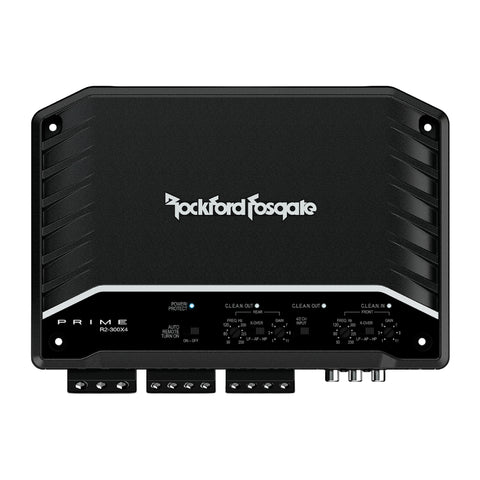
A 4-channel amplifier powers full-range speakers. Each channel drives one speaker, so a single amp can run a front left, front right, rear left and rear right speaker. Built-in high-pass filters keep deep bass out of small door speakers, which lets them play louder and cleaner without the cone bottoming out.
Four-channel amps can also be bridged. Bridging combines two channels into one stronger channel, so you can run your front speakers on channels 1 and 2 and a subwoofer on bridged channels 3 and 4. That turns one amplifier into a complete starter system.
The range of 4-channel amps is wide. The JCPower JC360.4 is an affordable Class A/B amp made for a first speaker upgrade. The Nemesis Audio NA-1600X4D delivers 200 watts RMS per channel at 2 ohms in a Class-D chassis. The JCPower RX-1600.4Dv2 steps up to 360 watts RMS per channel at 2 ohms for builds that need serious midrange output to keep up with large subwoofers.
Choose a 4-channel amplifier when your speakers sound thin, distort at volume, or simply cannot play as loud as you want on factory power.
Mono vs 4-channel amplifier at a glance
|
|
Mono (monoblock) |
4-channel |
|---|---|---|
|
Powers |
Subwoofers |
Door, dash and rear speakers |
|
Frequency range |
Low bass only |
Full range |
|
Typical load |
1 to 2 ohms |
2 to 4 ohms per channel |
|
Bridging |
Not needed |
Two channels combine for a sub |
|
Key controls |
Low-pass, subsonic, bass boost, remote |
High-pass, low-pass, gain per pair |
|
Best for |
Adding or upgrading bass |
Louder, clearer speakers; one-amp systems |
How to read RMS power and ohm ratings
The number that matters on any amplifier is RMS power. RMS is the continuous power the amp can deliver for as long as you play music. Peak or maximum power is a short burst figure that manufacturers print in large type on the box, and it is not useful for comparing amps or matching speakers.
RMS ratings always come with an impedance attached, for example "2000 watts RMS x 1 at 1 ohm" or "200 watts RMS x 4 at 2 ohms". An amplifier produces more power as impedance drops, but only down to the lowest load it is rated stable at. Run it below that rating and it overheats, cuts out or fails.
To match an amp to your speakers:
- Find each speaker's or subwoofer's RMS power rating.
- Work out the final impedance your wiring will present to the amp.
- Choose an amp that delivers between 75% and 150% of the speaker's RMS rating at that impedance.
Too little power is more dangerous than too much. An underpowered amp pushed hard starts clipping, sending a squared-off signal that heats voice coils and destroys tweeters and subwoofers. A stronger amp with the gain set correctly runs clean with headroom to spare.
Class-D vs Class A/B: does it matter?
Class-D amplifiers are smaller, run cooler and draw less current for the same output, which is why nearly every high-power subwoofer amp uses this design. Modern full-range Class-D amps also sound clean enough for speakers.
Class A/B amplifiers are larger and less efficient but have a long reputation for smooth, natural sound at modest power. For a budget speaker upgrade with moderate power, a Class A/B 4-channel amp is still a sensible choice. For anything above a few hundred watts, Class-D is the practical option for your electrical system.
Do you need both a mono and a 4-channel amp?
Most complete car audio systems use two amplifiers: a 4-channel for the speakers and a mono for the subwoofers. Each amp then works only on the frequencies it handles best, the subwoofer gets its own power supply, and you can set the bass level separately from the rest of the music.
If you want fewer components, there are two alternatives. A 5-channel amplifier combines four speaker channels and one subwoofer channel in a single chassis, which simplifies wiring and saves space. A digital sound processor, such as the PRV Audio DSP 2.8X 8-channel processor, adds time alignment, crossovers and equalization so a multi-amp system can be tuned precisely to your car's cabin.
Common mistakes when buying a car amplifier
- Comparing peak power instead of RMS power.
- Wiring subwoofers below the amp's lowest rated impedance.
- Using the gain control as a volume knob, which causes clipping.
- Reusing thin factory-style power wire on a high-power amp.
- Skipping the fuse at the battery.
- Ignoring the charging system on very large builds; amps above roughly 2000 watts RMS may need a high-output alternator or an extra battery.
Quick decision guide
- Only adding a subwoofer: buy a mono amplifier.
- Only upgrading door speakers: buy a 4-channel amplifier.
- Speakers plus one subwoofer on a budget: a 4-channel amp with channels 3 and 4 bridged.
- Speakers plus big bass: a 4-channel amp and a mono amp, or a single 5-channel amp.
- Keeping the factory radio: add a line output converter or a digital sound processor.
Frequently asked questions
Can I run a subwoofer on a 4-channel amp?
Yes. Bridge two channels into one and wire the subwoofer to the load the amp lists as bridged-stable, usually 4 ohms. Check the bridged RMS rating to make sure it suits your subwoofer.
Can a mono amp power door speakers?
No. A mono amp has one channel and plays only low frequencies, so it cannot drive left and right full-range speakers.
How many watts do I need for my speakers?
Most aftermarket 6.5-inch speakers are rated 50 to 100 watts RMS each, so an amp with 75 to 150 watts RMS per channel at your speakers' impedance is a good match. Pro audio midbass drivers often need far more.
Does a bigger amplifier mean louder bass?
Only up to what your subwoofer can handle. Once the amp matches the subwoofer's RMS rating, more output comes from more subwoofers, a better enclosure, or more efficient drivers.
Do I need a new wiring kit for a second amplifier?
Yes. Use a kit sized for the combined current draw, or run one larger power wire to a fused distribution block that feeds both amplifiers.
The right amplifier makes every other upgrade sound better. Start with what you want to power, match the RMS rating and impedance, and choose the setup that fits your space and budget. If you are still unsure, the CarAudioGarage team can help you match an amplifier to your vehicle and speakers.